
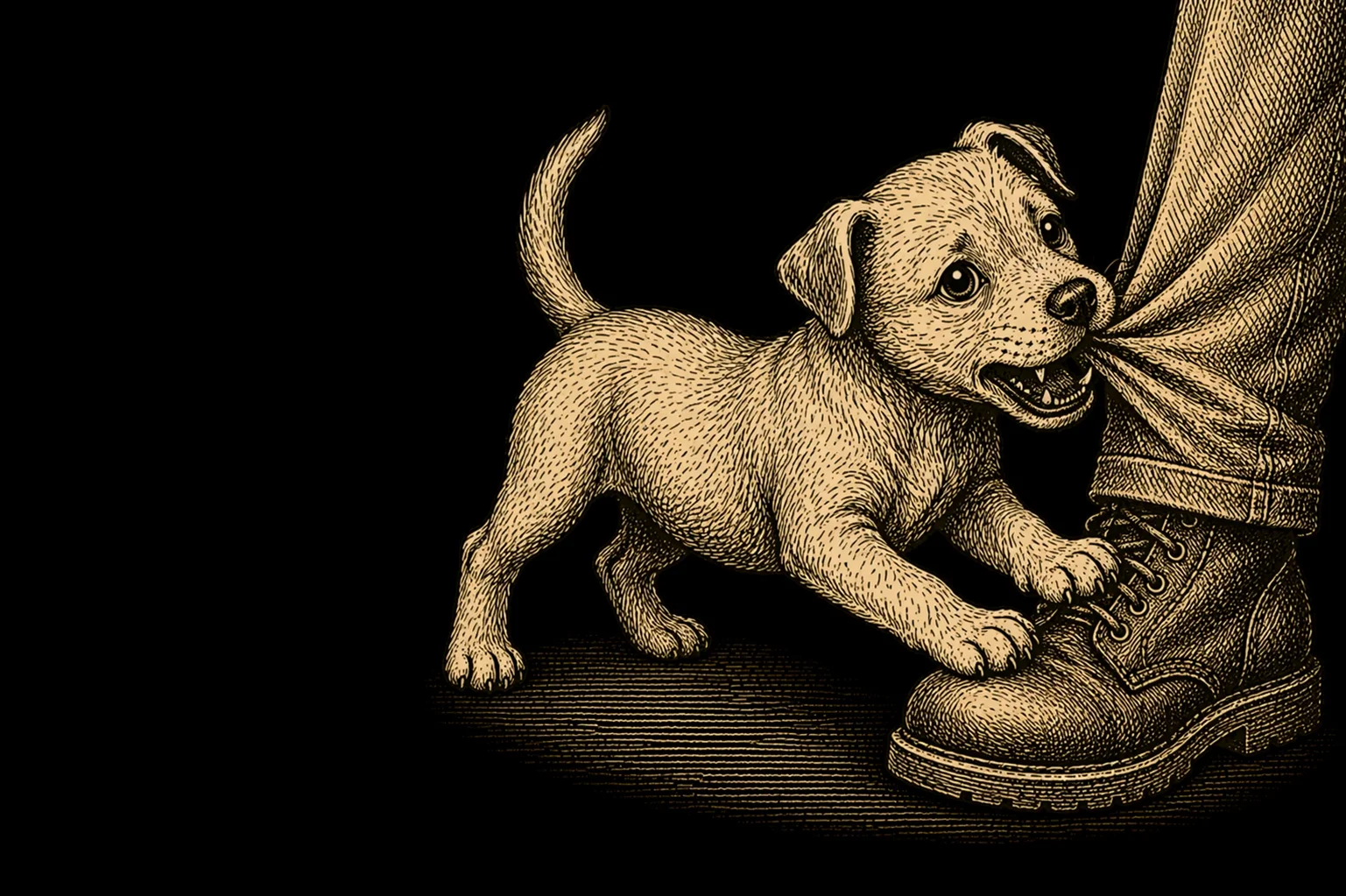
I can guarantee one of the first things anyone with a new puppy does - within days of them arriving - is frantically typing into Google: “Why does my puppy bite so much?”
Your puppy bites everything. Your hands, your clothes, your face, the furniture, the children, themselves. The biting is relentless, painful, and makes you question whether you've adopted a small Velociraptor.
Here's why puppies bite, why it's not aggression, why your current strategy might not be working, and ways to manage it effectively - not ‘stop’ it. Spoiler: those needle teeth have a job to do. If you're finding this period overwhelming, you're not alone
Why puppies bite
One of the first things that all the Googling will tell you is that puppy biting is normal. I know that doesn’t make it any less painful, but it is worth reminding yourself when it’s all getting too much that there are several reasons why it’s going on - none of which have anything to do with bad behaviour, and none of which suggest you’ve got a problem on your hands (excuse the pun).
Teething - Between 3-6 months, puppies lose their baby teeth and grow adult teeth. Their gums hurt. Biting relieves pressure. Everything goes in the mouth because everything might help soothe the discomfort.
Exploration - Puppies don't have hands. They investigate the world with their mouths. That texture, temperature, taste, resistance - they're learning what things are by biting them. Saying you should stop your puppy biting is a bit like saying your should handcuff your baby to keep them out of danger when they are exploring the world around them!
Play - Puppy play is bitey. In a litter, puppies bite each other constantly - faces, ears, legs, tails. It's how they learn bite inhibition, practice coordination, burn energy. When they play with you, they're doing what worked with their siblings: biting. I know this is probably a big ask in the heat of the moment, but I think it’s really helpful to try and get into the mindset that it’s a privilege that they want to engage with you in this way - they are offering to play with you, which shows that they are comfortable around you. How much more worrying would it be if they constantly shied away from you, which would certainly start to be the case if you were to use punitive measures to stop them biting as a form of play.
Attention-seeking - You're boring when you're on your phone. You're interesting when you yelp and engage with the puppy. Biting gets a reaction - even a negative reaction is attention. The puppy learns that biting makes the human interesting.
Overstimulation - Puppies have two modes: sleep or chaos. When they're overtired, overstimulated, or haven't burned enough energy, the biting intensifies. They're not trying to hurt you - they're dysregulated and biting is their outlet.
None of this is aggression. Aggression is about creating distance or controlling resources. Puppy biting is about gathering information, relieving discomfort, or engaging with you. The intent is completely different. Try and remember that the ‘problem’ really isn’t the puppy biting you - that’s natural behaviour - the problem is our reaction to it. The question should never be ‘how do I stop my puppy biting?’, because biting plays and essential role in their development, it should always be ‘how do I manage it in a way that works for both of us?’
Why "no" doesn't work
You say "no." The puppy pauses for half a second, then bites again. You say "no" louder. Same result. You say "no" and push them away. They bite harder.
"No" doesn't work because:
It's not information - "No" tells the puppy what not to do. It doesn't tell them what to do instead. They still have the drive to bite (teething, exploration, play, energy), and you haven't given them an outlet or an alternative. So they bite again etc. etc. seemingly ad infinitum.
It's inconsistent - You say "no" when they bite your hand but have fun with them when they bite the toy. You say "no" when you're working because you don’t have the time encourage an alternative behaviour, but tolerate it more when you're playing because it makes more sense in that context and perhaps you’re in ‘training mode’. The puppy can't extract the rule because the rule keeps changing.
It's attention - For an attention-seeking puppy, "no" is still engagement. You've stopped what you were doing and focused on them. That's reinforcing the behaviour, even if you're annoyed. The puppy just learns that biting gets attention, and attention is precisely what they are looking for.
It escalates arousal - Shouting, pushing away, waving your arms around to try and escape those teeth - all of this amps the puppy up. You've just made the game more exciting. The biting intensifies because you've increased their arousal level.
Saying "no" feels like you're doing something. You're not. You're just making noise while the puppy continues the behaviour you're trying to stop.
I also think it’s worth trying to flip the whole situation psychologically. ‘No’ implicitly means that they are doing something ‘wrong’ obviously. But why would you want to suppress the behaviour when it’s such a vital part of their development. Something that made my blood boil the other day was a clip that came up on one of my social media feeds in which a trainer advocated shoving a gloved hand into the back of the puppy’s mouth to, and I quote, “suck the joy” out of biting.
That’s a perfect example of an antiquated methods that does ‘work’ but at what cost? Bite inhibition is one of the most important lessons that puppies can learn to live harmonious lives in the human world, and all you’re doing with this sort of moronic ‘technique’ is suppressing a behaviour, because it’s such an unpleasant experience for the puppy, that can all too easily emerge again in later life, but with considerably more pernicious outcomes than a little scratch on the hand. PLEASE don’t try that method at home, what ‘works’ in the short term can equally create bigger, and more serious, problems in the future. OK, rant over.
Why redirection can fail
"Redirect to a toy" is standard advice. And it’s largely good advice - sometimes it works beautifully if you’re consistent. But many people also complain that they just they ignore the toy and go straight back to your hand.
Why redirection can fail:
Timing - If you offer the toy after they've already started biting you, you've just reinforced biting you. The sequence the puppy learns is: bite hand = toy appears. You've accidentally taught them that biting your hand produces toys.
Value mismatch - Your hand is warm, reactive, interesting. A rubber toy is not. If the toy isn't higher value than your hand, the puppy won't take it. You're offering them something boring in exchange for something fun.
Energy mismatch - A tired, overstimulated puppy doesn't want a toy. They want to sleep. Offering toys when they're dysregulated doesn't address the actual problem.
Redirection does work sometimes - when the toy is genuinely more interesting, when your timing is perfect, when the puppy is in a state where they can learn. But a lot of the time, it's just delaying the inevitable next bite.
Useful strategies
Bite inhibition, not bite prevention
You can't stop a puppy biting. You can teach them to bite softly. This is bite inhibition - the most important thing puppies learn in the litter before you take them home.
When puppies play with each other, they bite hard, someone yelps, the play stops. They learn that if they bite too hard, fun ends. Over hundreds of repetitions, they learn to modulate pressure. By 8 weeks, they've learned not to bite their siblings hard. They haven't learned not to bite you hard yet - that's your job.
This approach teaches the puppy without using aversive methods or corrections
How to teach it:
When the puppy bites too hard, immediately go completely still and boring - hands in pockets, no eye contact, no talking. Wait 3-5 seconds. Then re-engage. If they bite gently, the play continues. If they bite hard, you become a statue.
You're teaching the same lesson the litter taught: hard bites end the game. Gentle bites keep it going.
Don't yelp - it works for some puppies but for many it just makes them more excited. Don't push them away - that's engagement. Just become instantly, utterly boring.
This doesn't stop biting but it teaches the puppy to control the pressure, and that's the goal - by the time they're adult, you want a dog who knows how to use their mouth without causing damage.
Management: remove the opportunity
Tether the puppy - attach their lead to furniture so they can't chase you around biting your ankles while you're cooking.
Use baby gates - separate yourself when you need a break. The puppy can't bite you if they can't reach you.
Enforce naps - overtired puppies bite more. Puppies need 18-20 hours of sleep per day; if your puppy has been awake for more than 60-90 minutes, they need a nap. Crate them, cover the crate, let them crash. Most "behavioural problems" in puppies are just tiredness and although ‘enforced naps’ sound a bit harsh, they’re usually the kindest thing you can do.
Appropriate outlets
The puppy needs to bite something. Give them things that satisfy the drive:
Frozen carrots - cold, hard, relieves teething discomfort
Frozen Kongs - takes time to work through, tires them out
Puppy-safe chews - bully sticks, yak chews (only once they have their adult teeth at 4-6 months), puppy-specific dental chews
Snuffle mats, licki mats - redirects oral fixation into calmer activities
The more appropriate outlets they have, the less they'll target your hands.
Training an incompatible behaviour
You can't bite and do something else at the same time. Teach behaviours that are incompatible with biting:
Sit - they can't bite your hand if they're sitting for a treat
Go to bed - they can't bite your ankles if they're on their mat
Tug - channels biting drive into a structured game with rules
When you see the puppy gearing up to bite, cue the incompatible behaviour before they start. Think prevention, not reaction.
The timeline
Puppy biting usually peaks around 12-16 weeks (teething is worst here), sometimes a bit longer, then gradually decreases. By 6 months, most puppies have learned reasonable bite inhibition. By 8-10 months, they've mostly stopped.
It's not instant. You'll have good days and terrible days. As with so many other things in effective puppy training and development, stop looking for overnight changes - the best results come from patience and persistence. And remember, it will end!
The Dog’s Honest Truth
Those needle teeth exist for a reason. They're sharp so that when puppies bite too hard, it hurts - which teaches them to stop. If puppy teeth weren't sharp, they wouldn't learn bite inhibition. The pain is the feedback mechanism.
Your job isn't to stop the biting - it's to teach the puppy what's acceptable. Soft mouth good, hard mouth bad. Toys yes, hands no. Calm biting okay, frenzied biting ends the game.
"No" doesn't teach that. Management prevents the behaviour but doesn't teach the skill. Bite inhibition training teaches the skill. All three together - management when you’re at your limit, training when you have capacity, and letting the puppy learn consequences when they bite too hard - get you through it.
The biting ends. The puppy grows up. And in a year, you'll have a dog with a soft mouth who knows how to play without drawing blood. I teach bite inhibition as part of my puppy foundation training programmes.
But right now: baby gates, frozen carrots, and enforced naps. You'll survive it.