
How Much Sleep Does a Puppy Need? (And Why It Matters So Much)
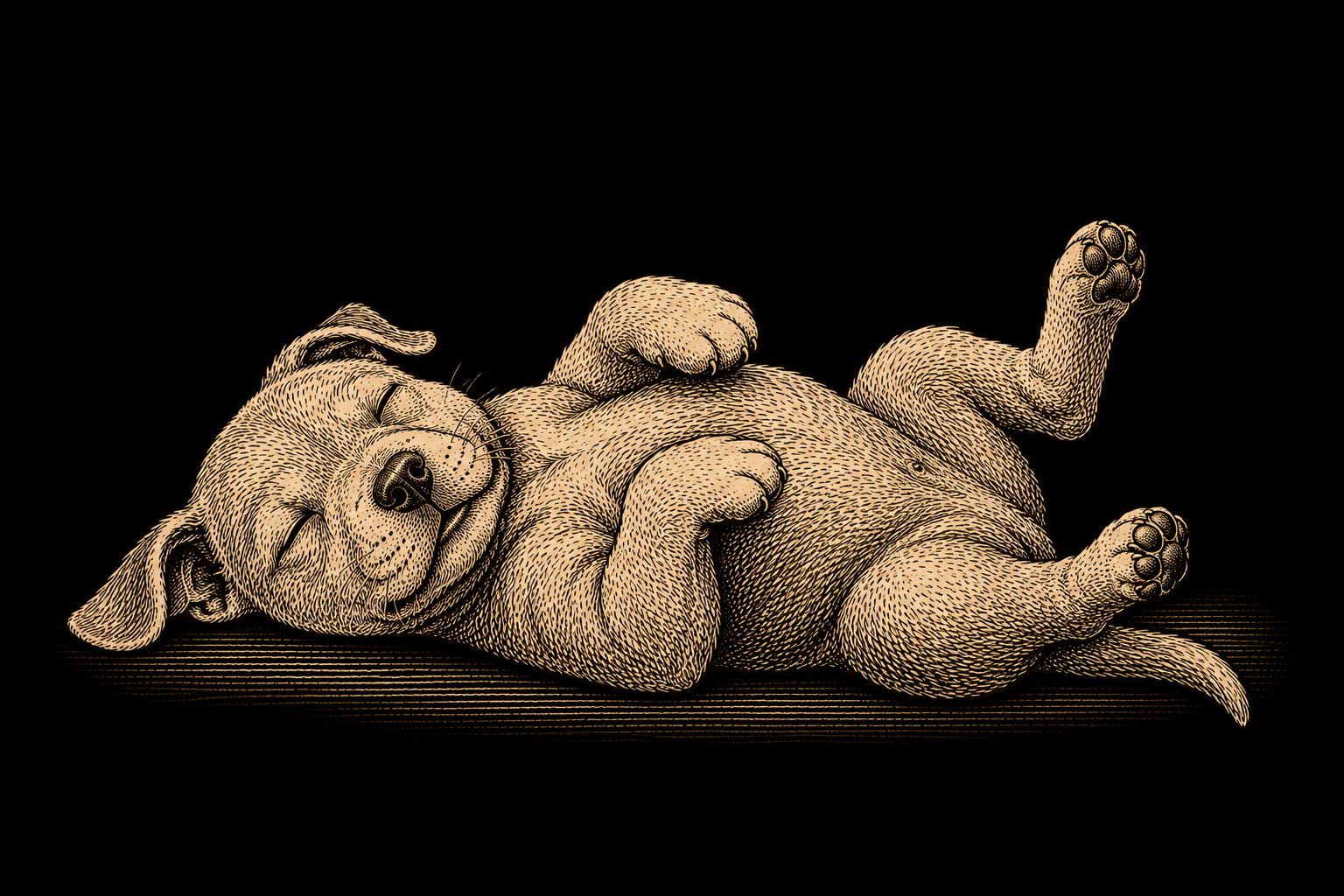
Over the last few weeks I've worked with three puppies from very different breeds: a working line Lab with energy to burn, a Shih Tzu who wanted to be glued to his owner, and a whippet who, on paper, was already sleeping plenty. But in each case, the puppy blues were starting to kick in, and their owners were at a loss to know what to do with the little Tasmanian devils bringing chaos to their homes.
All three had one thing in common. None of them was getting the sleep they needed, and the sleep they did get wasn't structured in a way that helped. A week later, after some properly planned naps, all three were different pups.
How much sleep does a puppy actually need?
The figure you'll hear from most trainers is 18 to 20 hours in every 24, and it still takes most of my new puppy clients by surprise. Younger puppies sit at the top end of that range, and it eases off gradually as they grow, although adolescent dogs still need a lot more rest than people tend to expect.
It's worth doing the maths on it, because it changes how a day with a puppy looks. If your puppy sleeps for 18 hours, that leaves six awake, and once you've taken out toilet trips, meals and the bits of the day you can't avoid, there isn't much left over for walks, play, training and visitors. Those awake hours also don't come in one long block. They come in short bursts, with a sleep in between each one.
That's the same for the Labrador, the Shih Tzu and the whippet. Breed changes plenty about a dog, including how much they'll fight sleep, but the amount a puppy needs stays roughly the same whatever they were bred to do.
Why so much? Their bodies are doing a lot of building
Puppies grow at a speed that's easy to forget when you're with them every day. A working line Lab can go from something you can hold in one arm to a dog with real weight and power in a matter of months, and all of that growth, the bone, the muscle, the joints holding it together, needs resources and downtime to happen.
As in other mammals, a good deal of that repair and growth work is tied to deep sleep, which is when the body gets on with building and mending rather than spending its energy on moving around and taking things in. Sleep also supports the immune system, which matters for a young animal meeting new places, new dogs and new germs for the first time.
There's a practical side to this too. A puppy who's tired is a puppy who's clumsier, and young joints aren't built for a lot of tearing about on wooden floors or bouncing off the sofa. Rest gives the body time to recover from all the play and exploring they've already done.
And their brains are doing even more
Everything is new to a puppy. The hoover, the bin lorry, the feel of grass, the sound of their own name, what happens when they sit, all of it is information their brain has to make sense of, and a lot of that sorting happens while they sleep. Sleep is also when a puppy gets the chance to reset emotionally. An overtired puppy has far less capacity to cope, which is why tiredness so often shows up as more biting, more frantic behaviour and a puppy who seems to have forgotten everything you taught them that morning.
I recently made an Instagram post about this - you can follow me at pupmeister.uk - and it’s something I share with all my new puppy clients to help them get the best value for money from their training! A team at Eötvös Loránd University in Budapest taught a group of pet dogs, who already knew "sit" and "lie down" in Hungarian, to do the same things in response to the English words instead. The dogs then had a three-hour sleep while wired up to EEG monitors that recorded their brain activity, and were tested on the English cues when they woke. As a group, they did better after the sleep than they had before it. When the researchers went back over the recordings, the dogs who showed more sleep spindles (short bursts of brain activity during deep sleep that are linked to memory in humans too) were the ones who remembered the new cues best.
The second part of the study took 53 dogs through the same English lesson and then split them into four groups for the following hour. One group slept, one went for a walk, one ate from and played with a Kong, and the fourth was taught a new, unrelated behaviour on top of the English cues. When the dogs were tested again a week later, the sleep, walk and Kong groups had all improved. The only group that hadn't was the one that had been taught more straight away, which suggests that giving a dog a break of some kind after a training session does more good than carrying on with more training.
I found that fascinating, partly because it puts some evidence behind something trainers have been saying for years, and partly because it gave me a better way of explaining it to clients. When you've just done a little training session with your puppy, the nap afterwards is part of the session, because it's when a lot of the learning gets stored, so it's well worth letting them have it.
How they sleep matters as much as how long
You can add up the hours a puppy spends lying down and get to a respectable number without them having had much proper rest at all. A puppy dozing in a bed in the middle of a busy kitchen, lifting their head every time the fridge opens or someone walks past, is spending a lot of time with their eyes shut while drifting in and out of light sleep. The deep, settled sleep that does the growing and the memory work needs a puppy who feels safe enough and undisturbed enough to properly switch off.
That's where the setup helps. A crate or pen in a quieter part of the house, partly covered if your puppy likes it darker, gives them somewhere that means sleep, and it means they're not being woken by the household carrying on around them. Something to chew or lick before a nap, or a few minutes of sniffing out scattered food, helps bring them down from whatever they were doing before.
The structure of the day matters too. A puppy who sleeps well at night but then catnaps their way through a busy day can still end up running on empty by the evening, which is often when the witching hour kicks in. What tends to work better is regular naps spread through the day, so they never get too far into the red before they get a chance to recover. And plenty of puppies won't take themselves off to sleep, however tired they are. The more overtired they get, the harder they fight it, so a lot of the time it falls to you to give them the opportunity.
One hour up, two hours down
The rule of thumb I give clients for young puppies is roughly an hour awake followed by roughly two hours asleep, repeated through the day. It's a useful starting point because it gives the day a shape, and it makes the 18 to 20 hours feel a lot more manageable once you can see where the sleeps go.
I'd treat it as a guide to work from, though, and keep an eye on the puppy in front of you. A very young puppy may only manage 40 minutes or so before they start to unravel, and an older one might cope happily with a bit longer. A busy hour, like a trip into town or a visit from friends, will tire them out faster than a quiet hour pottering in the garden, so the nap after it may need to come sooner and last longer.
The best guide is your puppy. When the biting ramps up, they start grabbing at clothes or the lead, they tear round in circles, or a cue they knew perfectly well this morning seems to have gone out of their head, that's usually a puppy telling you the awake window has run out. It's much easier to put them down for a nap before you get to that point than to settle them once they're past it.
Within each awake hour, you'll want to fit in a toilet trip, some food if it's due, a bit of play or a short training session, and then a wind-down before the next sleep. It doesn't need to be timed to the minute, and you'll find a rhythm that suits your household within a week or so.
Back to those three puppies
The working line Lab had plenty of natural drive, and her owners had done what lots of people do with a lively puppy, which was to try to tire her out with more walks and more games. It made sense on paper, but she was getting more wired as the days went on, and her evenings had turned into a run of mouthing and zoomies. Working line dogs will often keep going long after they should have stopped, so she wasn't going to put herself to bed. We kept the activity much the same and built a nap into the routine straight after each walk and play session, in her crate with a chew, and her evenings started to calm down within the week.
The Shih Tzu had the opposite problem. Companion breeds are bred to want to be near you, and he was far more interested in following his owner from room to room than in having a sleep. He was dozing on laps and at her feet, which looked lovely, but he woke every time she moved, so he never got a proper stretch of rest. A pen in a quiet room, a lick mat to help him settle, and a gradual build-up of time in there on his own gave him somewhere he could genuinely switch off.
The whippet was the one I'd least have expected. Whippets have a reputation for being champion sleepers, and on the face of it she was sleeping plenty, curled up in her bed for hours at a time. Her bed was in the kitchen, though, which is the busiest room in the house, with children coming and going and the back door opening and closing all day. She was lying down for a long time without getting much deep sleep, and when she was awake she was all over the place. Moving her bed into a covered crate in a quieter corner made a bigger difference than her owners expected.
Three very different puppies with very different needs, and the change that helped each of them came down to the same thing: better structured sleep, in a place where they could properly rest.
The Dog's Honest Truth
When a puppy is biting, bouncing off the walls or struggling to learn, it's natural to look for something to add, whether that's more exercise, more training or a new toy. Quite often the thing that helps most is giving them more good sleep, at the right times, somewhere they can properly switch off. It's one of the least exciting bits of raising a puppy, and it underpins pretty much everything else you'll do together, from their growing body to the cues they remember tomorrow.
If you're just starting out and want help building a routine that works for your puppy and your household, Puppy Foundations covers sleep and structure from day one. If your dog's a bit older and the evenings have already gone a bit wild, Teen Resets is a good place to sort it out. Or get in touch and we can talk through what's going on with yours.
Sources
Kis, A. et al. (2017) The interrelated effect of sleep and learning in dogs (Canis familiaris); an EEG and behavioural study. Scientific Reports, 7, 41873.
Iotchev, I.B. et al. (2017) EEG transients in the sigma range during non-REM sleep predict learning in dogs. Scientific Reports, 7, 12936.