
Why Does My Puppy Jump Up? (And How Do I Stop It?)
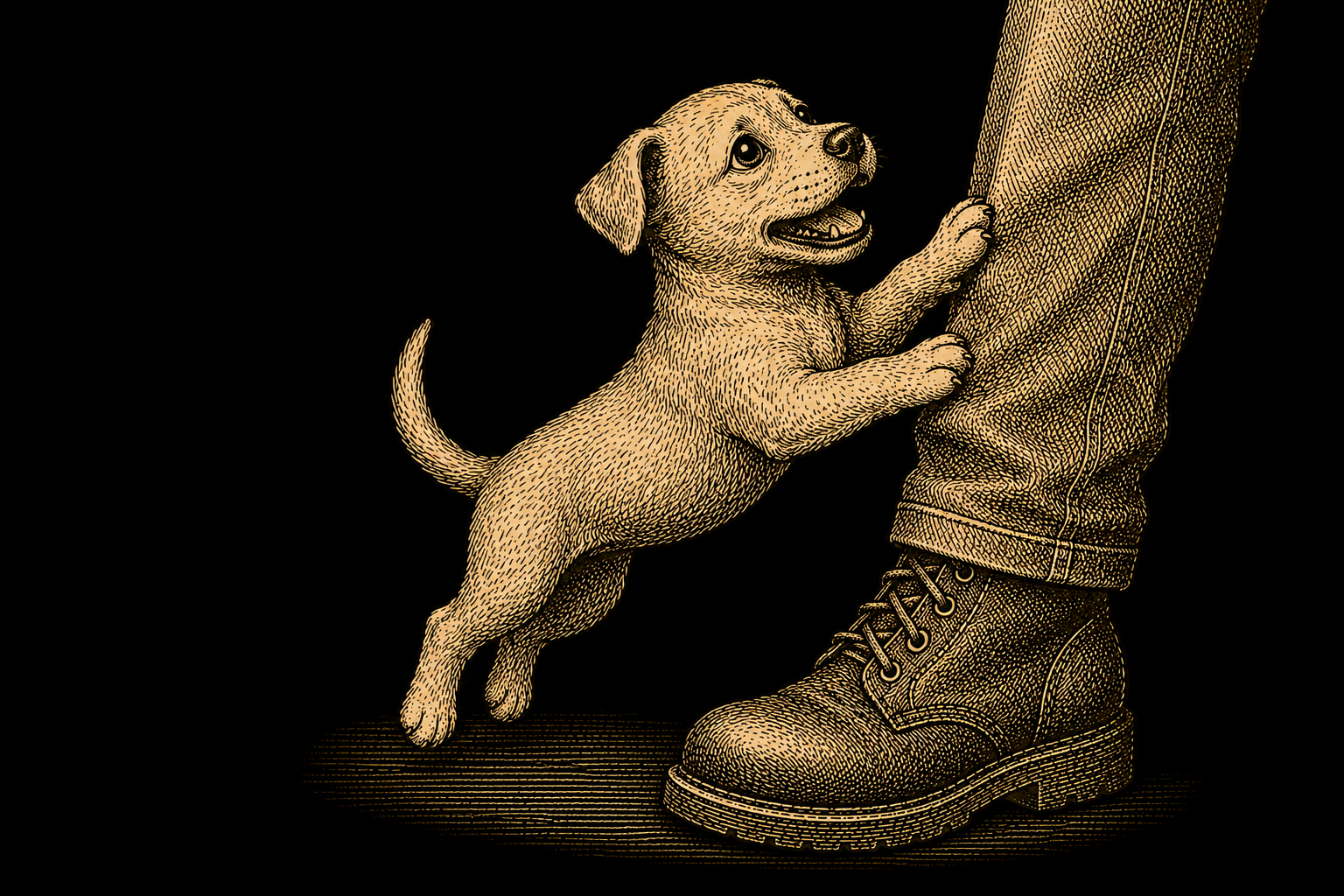
Reward “four paws on the floor” is the standard advice. It's mine too, and it's right. The part that often gets skipped is what makes it actually work: what you reward those four paws with, and what the jumping was getting your puppy in the first place.
Because a jump is a puppy trying to make something happen. Attention? A way outside? A game? A toy? Once you know what they're after, you can give them that same thing for keeping their feet on the floor, and that's when rewarding four paws really starts to stick.
Why they do it
A jump is usually a greeting, aimed at your face. Your puppy wants to get up near your head, and yours sits a good few feet higher than they can reach flat-footed, so up they go.
It carries on because it works. Somewhere along the line, jumping has produced something worth having: you looking down and talking to them, hands on them, the door opening, the walk starting, the game carrying on. Dogs repeat what pays. They've found a reliable way to get a result, and they'll keep using it until a better one comes along.
But puppies also jump for different reasons, so your first job is working out yours. And jumping is a habit, which means it's very changeable once you stop it paying and give your puppy a better option.
Step one: work out what the jump is getting
Before you change anything, spend a few days just watching. Every time your puppy jumps, note three things: what was happening just before, what they did, and what happened in the very next second. That last one matters most, because whatever follows the jump is usually what's feeding it.
You're looking for the pattern. Jumping the second you come through the door is usually about wanting you: your attention, your hands, a proper hello. Jumping when the lead comes out is about wanting the walk. Jumping while you plate up dinner, when you sit on the sofa, or halfway through a game, is each its own thing again. You don't need to tackle them all at once, and the fix won't be identical for each.
Step two: stop the jump paying off
You can't teach a new habit while the old one still works, so the first practical move is to make sure jumping stops getting your puppy what they want, even by accident.
Mostly that means not delivering the good stuff on the back of a jump. If they jump for contact, the contact pauses for a moment. If they jump when the lead appears, the lead stops moving and the door stays shut. Nothing dramatic, no telling off, you just quietly hold the thing they wanted until their feet are back on the floor. The message lands fast: jumping makes the good thing stop, grounded feet make it happen.
Where you can, cut down the rehearsals too. A baby gate, a house line, or greeting people in the hallway rather than the open-plan kitchen all reduce the number of times your puppy gets to practise launching at someone before you've taught them the alternative.
Step three: reward four paws with the thing they actually wanted
This is where "reward four paws on the floor" properly kicks on, and it works best when the reward is the very thing the jump was chasing.
If your puppy jumps for contact, then contact is the reward for keeping their feet down. When those paws are on the floor the fuss starts straight away. If they jump to get out of the door, then the door opening is the reward for four paws. You don't need a long, formal sit first. At the start, one second of grounded feet is plenty. Mark it, deliver the good thing, and build from there.
Speed is everything early on. The reward has to arrive the instant the feet are down, or your puppy won't join the two together. A treat works fine, but the functional reward, the walk, the greeting, the toy, teaches faster, because it's what they were after in the first place.
Step four: get in before they get too excited
A lot of jumping comes from a puppy who's already over the top and can't help themselves. You'll get much further heading it off than trying to switch it off mid-launch.
So hand over a little of what they want early, before they’re too wound up. A sociable puppy meeting someone does better with calm, low-key contact offered straight away than with a person holding back and waiting to be jumped on. You can also change the picture that sets them off: greet them crouched down at their level, or scatter a few bits of food on the floor as you come in, so their nose drops instead of their paws lifting.
Step five: give them an easy alternative
Finally, give your puppy something simple to do instead, one thing that fits the situation and is easy to pull off when they're excited.
Standing with four feet on the floor is the obvious one. Others that work well: a hand touch (nose to your palm), going to a mat or bed, or fetching a toy to carry, which is brilliant for the puppy who greets by grabbing. A sit is fine if it genuinely suits your dog, but don't force one at the exact moment they're most wound up, because that's often asking too much of them. Pick the easiest behaviour that does the job, and reward it well.
Putting it together: the common triggers
Here's how the five steps play out in the situations that actually catch people out.
When you come home
Keep your own arrivals boring. Big, excited hellos teach a big, excited response. Come in low-key, ignore the jumping (no eye contact, no words, no hands), and the moment their feet settle, crouch down and say hello properly at their level. Scattering a few bits of food on the floor as you step in works a treat, since it drops their nose to the ground and gives them a job that isn't launching at you.
When visitors arrive
This is the hard one, because visitors won't follow your rules. Set it up so your puppy can't get it wrong: a house line or a gate, and a mat a little way from the door for them to go to. Reward calm on the mat as the doorbell goes and the person comes in. Ask visitors to ignore the jumping and only give attention once four feet are down, and hand them a treat to reward it if they'll play along. If it all falls apart, no drama, just pop your puppy behind the gate and let things settle.
When the lead comes out
This one's very trainable, because you control the whole sequence. The lead only goes on while the feet are down, and the door only opens while the feet are down. If your puppy jumps, everything stops, the lead comes away, you wait. Feet down, and it all starts moving again. A few repetitions and most puppies work out that calm gets them out the door faster than bouncing does.
Food prep, the sofa, and mid-play
Same principle, different scene. While you're plating up, reward feet on the floor, or teach a settle on a mat in the kitchen. On the sofa, only invite them up or fuss them once they're grounded. In play, if the jumping gets too much, the game simply pauses for a second and restarts when they've landed. Calm keeps the good thing going.
A note on the harder stuff
A quick word on the more aversive methods because, despite the weight of contemporary evidence against them, they're everywhere: a knee to the chest, shouting, grabbing the collar, a spray bottle. I don't use them, for two reasons. They can frighten a puppy who was only coming in to say hello, and that worry can quietly spread to your hands, to visitors, or to the front door. And with a puppy who's jumping for attention they often backfire anyway, because someone who looks at them, shouts and grapples with them has just handed over a lovely pile of attention. None of it is needed when the reward-based approach works.
Give it time
None of this is instant, and the odd relapse is normal, especially with visitors or when your puppy is extra excited. And it’s essential to remember that it often gets worse before it gets better - if something used to work for them, they’re just going to try harder with the same behaviour to see if that works. But consistency is what finally gets you there, from everyone in the house and, as far as you can manage, everyone who visits. Jumping only has to pay off occasionally to keep it , so the aim is to make grounded feet the thing that reliably works, every time, for everyone.
The Dog's Honest Truth
You don't need a puppy who never puts their paws up, and you don't need to be the sort of owner who polices every greeting. What helps is understanding what the jumping is doing for them. A puppy who jumps is a puppy paying close attention to what works, and that's the raw material for everything else you'll teach them. Show them an easier way to get what they were after and the jumping fades on its own.
If you're just starting out and want to get greetings right before they turn into a habit, Puppy Foundations builds this kind of thinking in from day one. If your dog's older and the jumping has already dug in, Teen Resets is a good place to sort it out. Or get in touch and we can talk through what's going on with yours.