
Prey Drive in Dogs: What It Is and How to Use It in Training
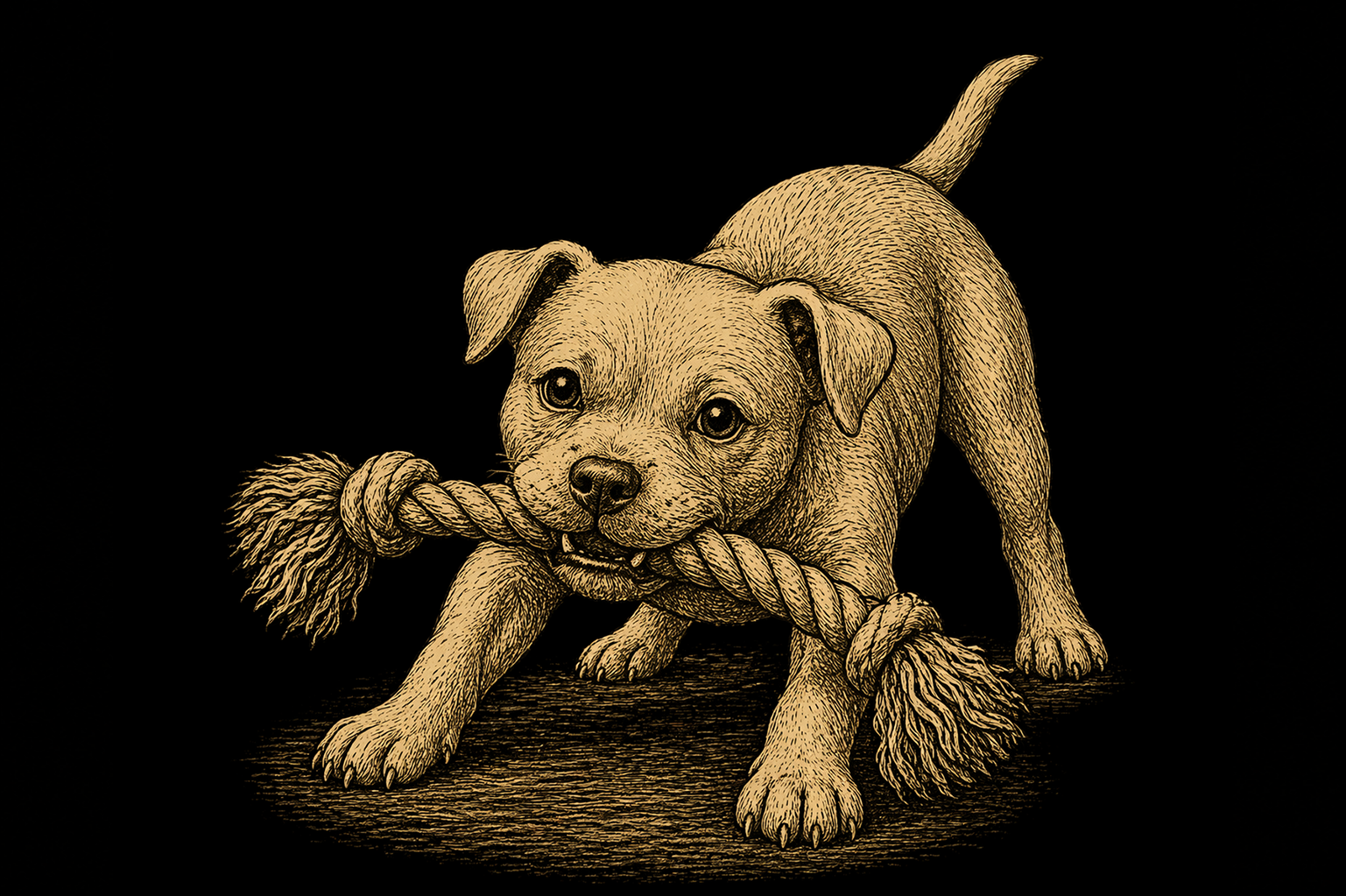
When a new client tells me their dog is impossible to motivate, the first thing I ask is what the dog goes crazy for. Nine times out of ten there's something: a ball, a squeaky toy, anything that moves fast. The owner usually mentions it apologetically, as if the obsession is part of the problem.
It isn't. It's one of the most useful pieces of information they can give me. Prey drive, properly understood and properly used, is one of the most powerful training tools available - and most owners are sitting on it without realising.
Understanding prey drive
Prey drive is the motivational system that compels a dog to pursue, catch, and in the full sequence, dispatch moving objects. It is a deeply wired predatory instinct that exists to varying degrees in every domestic dog, shaped by centuries of selective breeding for specific working roles.
The predatory sequence in its complete form runs: orient, eye, stalk, chase, grab-bite, kill-bite, dissect, consume. Different breeds were developed to express different parts of that sequence, and that's the key thing to understand. Border Collies were bred for the eye and stalk: that fixed, low, intense stare that holds sheep in place. Retrievers were bred for the chase and grab without the kill, which is why they have soft mouths and will carry things all day. Terriers were bred for the grab-bite and kill-bite, which is why they shake. Sighthounds were bred for explosive, sustained chase over distance.
Most pet dogs express a truncated version of the sequence. Most of the things owners describe as problems, chasing squirrels, fixating on cyclists, losing their mind over a ball, are prey drive without a productive outlet. The drive is there - what's missing is structure around it.
Why it matters for training
Reward-based training works by making the behaviour you want more reinforcing than anything else the dog could be doing. For many dogs, food is sufficient reinforcement in a quiet environment. The moment the environment gets interesting, a piece of chicken starts competing with squirrels, other dogs, interesting smells, and everything else the outside world offers. Sometimes the chicken loses.
Prey drive is different. A dog in genuine prey drive arousal isn't weighing up a treat against a distraction. They're in a motivational state where the chase, the catch, and the tug are intrinsically compelling. If you can position yourself as the source of that experience, you stop competing with the environment - you become more interesting than it.
Working dog trainers in police, military, and sport contexts have understood this for decades. The same principle applies to pet dogs. Any dog with sufficient drive can be trained this way, and the results are often faster, more durable, and more reliable in high-distraction environments than food-only approaches.
The predatory sequence in play
A great example of practical application of prey drive in training is structured play, and specifically tug. A good tug session isn't just exercise. It runs the dog through a modified predatory sequence: the chase (you animate the toy), the stalk (you let tension build before the grab), the catch (they take it), the tug (they fight it), and the out (they release on cue). Done well, this is deeply satisfying for a prey-driven dog in a way that food rarely matches.
What makes it a training tool rather than just a game is the structure that surrounds it. The dog learns that specific behaviours produce the game: eye contact, a sit, a down, coming back on recall. The game becomes the reward. And because the game is genuinely compelling, the behaviours that produce it become reliable even when other things are competing for the dog's attention.
Three things make tug particularly effective:
You control the game. The toy only comes alive when you make it move. A toy sitting on the floor is uninteresting. You animating it is everything. That gives you something to withhold, which gives you real leverage.
The arousal is manageable. Chasing a ball can wind some dogs into a state where they can't think straight. Tug involves you directly. You are part of the loop, which means you can bring arousal up and bring it back down.
It builds the relationship. The dog learns that you are the source of the best thing that happens to them. That changes how they orient to you on a walk, in a park, anywhere there are distractions. A dog who associates you with that level of reward checks in more, stays closer, and is genuinely more engaged.
For tug to work the toy needs to hold value, which means it needs to be reserved for training. Not a tennis ball the dog has had access to all week. Something that only appears when you're working. The Tug-e-Nuff range, which I always recommend to clients, was designed specifically with this in mind: high-value training toys that stay novel because they only come out in sessions. As a Pupmeister partner, I can get you a discount - get in touch for details.
Recall and prey drive
Recall is where prey drive tends to do its most impressive work. If your dog is in that six-to-twelve-month window where recall has suddenly fallen apart, this post explains what's happening neurologically. The short version is that the environment is winning. The garden has no competition. The park has squirrels, other dogs, interesting people, and a thousand smells. Standing there with a piece of cheese, you are not winning that contest.
Now imagine that coming back to you reliably predicts a tug game with their favourite toy. The squirrel is exciting, but the squirrel doesn't play tug. You do. And you have proven, through hundreds of repetitions, that coming back to you is the beginning of something brilliant rather than the end of freedom.
This is the principle behind a play recall: calling the dog back not to end the session, but to engage in a short, high-value tug game before releasing them again. The dog learns that recall means the good stuff happens, not that it stops. Over time, that association becomes strong enough to compete with most distractions.
Build it first in low-distraction environments. Call the dog, produce the toy the moment they arrive, have a short game, release them. Repeat until it's solid. Then raise the difficulty gradually. Don't try to proof it in environments where you know you'll lose. That just teaches the dog that recall is sometimes optional.
Using drive in everyday training
You don't need to save prey drive for formal sessions. Once a dog understands that certain behaviours produce the game, you can use short play rewards throughout a walk or a training session wherever it's practical.
As a marker reward. Instead of always following a correct behaviour with food, occasionally produce the toy for a short tug. Variable reinforcement schedules are more resistant to extinction than fixed ones. The unpredictability increases the value.
For loose-lead walking. A dog who knows that checking in with you sometimes produces a tug game has a strong incentive to stay close and make eye contact. It is one of the most underused tools in building reliable loose-lead walking.
For the out cue. A reliable out or drop is essential if you're using tug as a reward. Dogs who understand the structure of the game learn quickly that releasing the toy is what makes the game restart. Out doesn't end the fun. It produces more of it.
For arousal management. A dog who has learned to tug on cue has a built-in regulation tool. In situations where arousal is climbing, a short structured tug session can bring it into a productive range and then back down before you continue. It isn't distraction. It's regulation.
Which dogs benefit most
The dogs who benefit most from having drive channelled into training are often the ones causing the most problems. High-energy adolescents who can't focus. Breeds with strong working drives who seem impossible to reach with food alone. Dogs who go berserk in the park and can't be recalled. If that's where you are, Teen Resets is built for exactly this stage.
These dogs often get labelled as too much or untrainable. They're not. They're dogs with a lot of drive and nowhere useful to put it. Give the drive an appropriate outlet and a structure it can work within, and they tend to become the most rewarding dogs to train: responsive, motivated, and genuinely engaged.
The approach works particularly well with Spaniels, Retrievers, German Shepherds, Belgian Malinois, Border Collies, most terrier types, Staffies, and working or sporting breeds generally. That said, drive varies within breeds as much as between them. Some dogs are more food-motivated than toy-motivated, and forcing tug on a dog who isn't interested serves no one. Read your dog.
If you've got a high-drive adolescent who's currently a handful, the Terrible Teens survival guide is worth downloading. The adolescent phase is when getting drive into training pays off most, before the habits of ignoring you become established. One thing to avoid during that window: using corrections to suppress the drive. Here's why that tends to make things worse.
The Dog's Honest Truth
The dogs who are hardest to reach with conventional training are often the ones with the most drive. The dog who blows you off for a squirrel, who can't be recalled away from another dog, who seems to be operating on a completely different channel in the park: that dog isn't defective. They're highly motivated. The question is whether that motivation is working for you or around you.
Getting it working for you takes time. It takes consistent, structured play sessions, patience in proofing across environments, and a willingness to invest in the relationship as a training tool rather than just a nice side effect. But the dog who checks in on walks, comes back reliably, and works with you rather than independently: that's the same drive, pointed somewhere useful.
If you want help building structured play into your training, for a puppy or an adolescent dog, get in touch or explore the Puppy Foundations and Teen Resets programmes.