
Your Dog Isn't Stubborn. They're Just Rational.
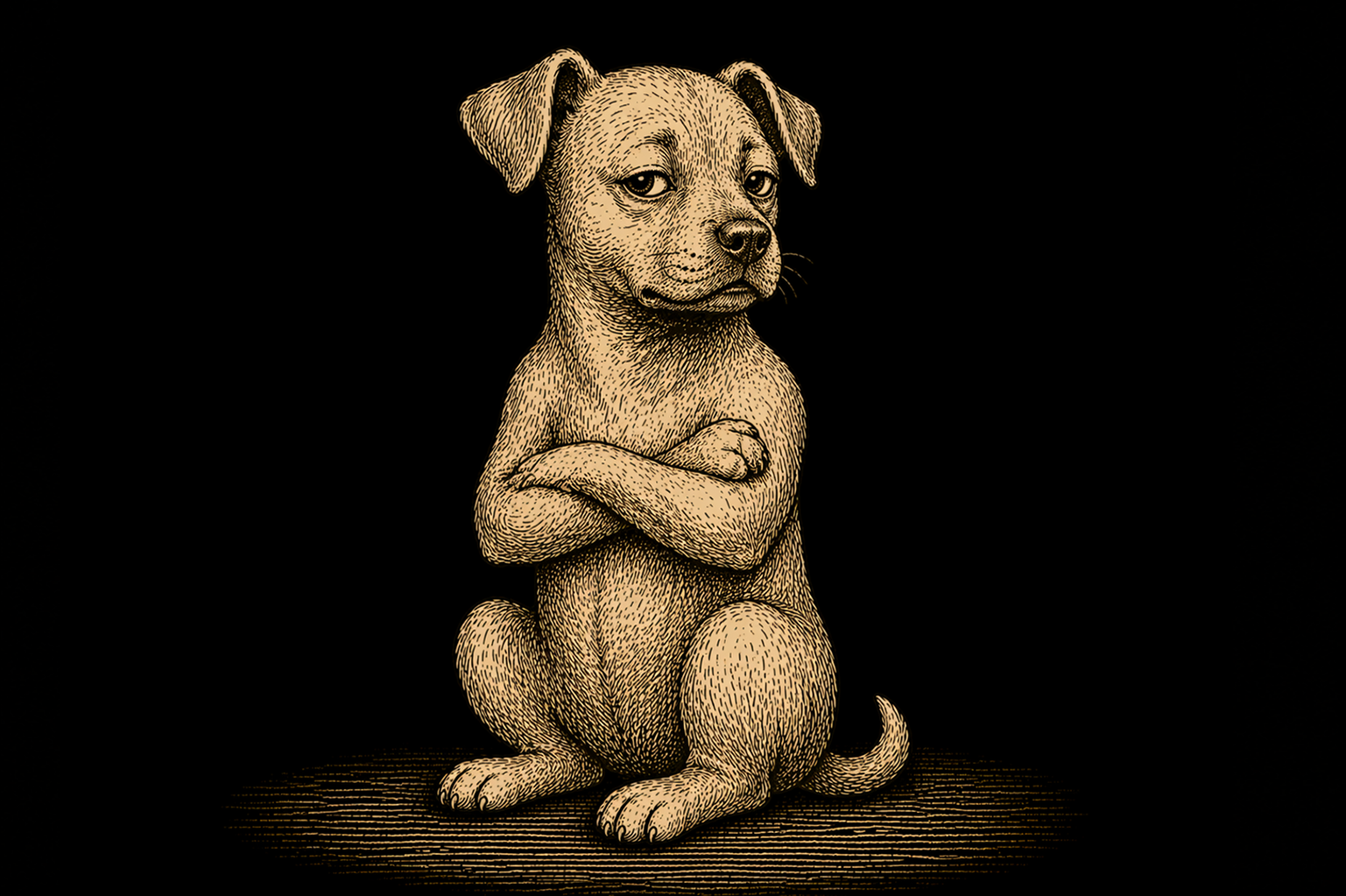
One of the most common things I hear from new clients is some version of: ‘he knows what I'm asking, he just doesn't want to do it’. They’ve bought into the idea that their dog is ‘stubborn’.
I understand why people feel that way. When a dog performs a behaviour perfectly at home and then appears to completely ignore the same cue outside, it looks like a choice. And in a sense, it is. But it's not the choice people think it is.
Here's the way I think about it: there is no such thing as a stubborn dog. If a dog isn't doing what you're asking, one of two things is true: either they don't understand what's being asked, or they're not motivated enough to do it. But both of them are things you can do something about.
What ‘stubborn’ really means
When we call a dog stubborn, we're applying a human concept to an animal that doesn't operate the way humans do. Stubbornness implies deliberate resistance: knowing what's being asked, understanding the consequences, and choosing to ignore you anyway. That's a sophisticated cognitive process. It requires a theory of mind, an awareness of the other party's expectations, and a decision to frustrate them. Dogs are not doing this.
What dogs are doing is considerably simpler and considerably more logical. They are making decisions based on what has been reinforced. A behaviour that produces a good outcome gets repeated (which by the way, is the core principle behind positive reinforcement). A behaviour that produces nothing, or produces something unpleasant, gets dropped. This isn't stubbornness. It's operant conditioning, and it works the same way in every animal, including humans.
The dog who ignores a recall in the park isn't deciding to defy you. They're in an environment where, historically, coming back has produced either nothing particularly interesting or the end of the walk. The park itself, by contrast, is producing squirrels, smells, other dogs, and a generally excellent time. The dog is doing a rapid cost-benefit analysis and arriving at a perfectly rational conclusion. You haven't made the right choice rewarding enough.
The context problem
One of the most common scenarios I see is the dog who performs beautifully at home and falls apart outside. What's actually happening is that the dog has learned the behaviour in one context and hasn't yet been taught to generalise it to others.
Dogs don't generalise the way humans do. A sit trained in the kitchen is a kitchen sit. It doesn't automatically transfer to the park, or the vet's waiting room, or the pavement outside school at pick-up time. Each new environment requires the behaviour to be retrained in that context, at least partially, before it becomes reliable there.
The dog isn't being difficult. It's how dog cognition works. . They're in a new situation where the rules haven't been established yet. From their perspective, the behaviour hasn't been taught here.
Add to this the role of distraction. Every environment has a distraction threshold. Below that threshold, the reinforcement you're offering is sufficient to compete with everything else going on. Above it, it isn't. A dog who responds perfectly when there's nothing more interesting around and ignores you when there is hasn't regressed. Their threshold has simply been exceeded. The training hasn't yet been built to the level the environment demands.
The reinforcement history
When a dog reliably doesn't do something we're asking, there's almost always a reinforcement history that explains it. Either the behaviour was never reinforced sufficiently in the first place, or it was inconsistently reinforced, or competing behaviours were inadvertently reinforced instead.
Inconsistency is one of the biggest culprits. A dog who sometimes gets a reward for coming back and sometimes gets nothing has learned that recall is unpredictable. A dog who sometimes gets a reward for sitting before meals and sometimes gets the bowl regardless has learned that the sit is optional. Humans find it easy to make exceptions. Dogs find it very easy to notice that exceptions exist.
The other common issue is that the reinforcement offered isn't actually reinforcing for that dog in that context. A piece of kibble might be sufficient motivation in the kitchen before breakfast. The same piece of kibble is unlikely to compete with a squirrel. This doesn't mean the dog is being difficult. It means the reward isn't valuable enough relative to what's on offer from the environment. Upping the value of the reward, or using something the dog finds more compelling like structured play, often produces an immediate change in the behaviour that was previously being called stubborn.
Breed and genetics
It's worth acknowledging that some breeds attract the stubborn label more than others, and that this often says more about the breed's motivational profile than their willingness to cooperate. Bull breeds are probably the most common example I encounter. Staffies, French Bulldogs, English Bulldogs: they're frequently described by their owners as wilful, headstrong, or just not that interested in training.
What's actually going on is that bull breeds were not developed for the kind of handler-focused, immediate responsiveness you see in working breeds. They're people-oriented dogs, but they're also dogs with a high arousal threshold, a lot of physical confidence, and a reinforcement history shaped by decades of being bred for tenacity rather than compliance. They respond extremely well to training when the reward is actually worth something to them, and when the training is consistent. Low-value rewards in high-distraction environments produce exactly the indifference that gets called stubbornness.
The same principle applies across breeds. Understanding what a breed was developed to do, and what genuinely motivates them, is more useful than any amount of repetition or pressure. I cover this in more detail in the breed spotlight series in this blog (check out the Pupdates home page for breed-specific-posts), and it's one of the first things I look at with any new client.
What to do instead
If the stubborn label is getting in the way, the most useful thing is to replace it with a question: what is this behaviour telling me about my training?
If the dog doesn't respond in a particular environment, the environment is too distracting for the current level of training. The answer is to build the behaviour in easier environments first and raise difficulty gradually.
If the dog performs inconsistently, the reinforcement is inconsistent. The answer is to be more deliberate about when and how behaviours are rewarded, and to make sure the reward is actually worth something in context.
If the dog seems unmotivated, the reward isn't competing with what the environment is offering. The answer is to find out what actually motivates that dog and use it. For many dogs, particularly those with strong working drives, that means moving away from food and towards structured play and prey drive.
If the dog reliably does something other than what you asked, there's a competing reinforcement history at work. The answer is to identify what's been reinforcing the alternative behaviour and remove it, while building a stronger history for the behaviour you want.
None of this is complicated in principle. It requires observation, consistency, and a willingness to look at the training rather than the dog's character when something isn't working.
The Dog's Honest Truth
Dogs are not complicated in their motivations. They do what works. When a behaviour stops working, they stop doing it. When a behaviour starts working, they do it more. The dog who ignores you isn't plotting against you. They're responding logically to the information their reinforcement history has given them.
The shift from thinking about stubbornness to thinking about reinforcement changes everything about how you approach training. Instead of trying to override the dog's will, you start asking what would make this worth their while. That question almost always has a practical answer, and finding it is considerably more productive than concluding that the dog is just being difficult.
If you're working through a training problem that feels like it's coming up against a brick wall, get in touch or have a look at what the Puppy Foundations and Teen Resets programmes cover. Sometimes what looks like a character problem turns out to be a training gap, and training gaps are fixable.