
Why Your Teenage Dog Pulls Worse on Lead Than They Did as a Puppy
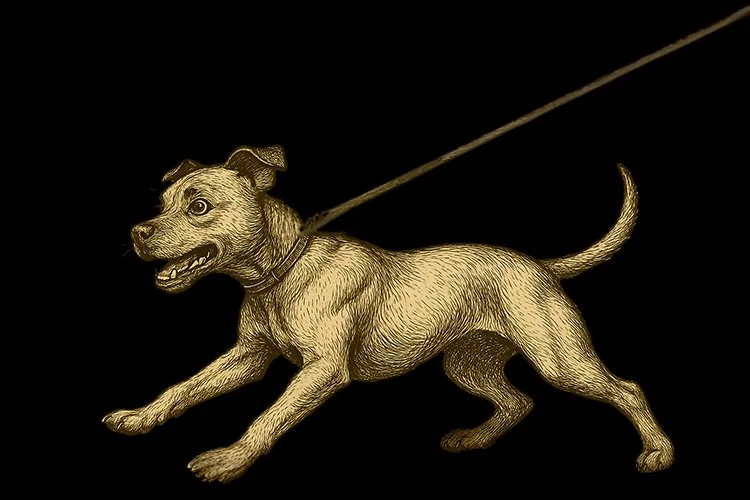
I see this constantly with teenage dogs. Lead walking that looked solid at four months completely falls apart by six or seven months. The puppy who barely pulled, who checked in regularly, who made walks easy, suddenly becomes a different dog. Walks become hard work.
It's frustrating, especially when the early training was done properly. But this isn't about training standards slipping or the dog deciding to ignore you. Fundamental neurological shifts occur during adolescence that makes pulling almost irresistible, even for dogs who had excellent loose-lead skills as puppies. The dog hasn't forgotten what you taught them. Their brain is just working against them right now.
Why lead pulling gets worse during adolescence
Between six and eighteen months, your dog's brain undergoes massive reorganisation. This isn't a training problem you can fix with better technique—it's a developmental stage you have to manage while their brain reorganises itself.
Dopamine sensitivity spikes
Adolescent dogs experience a surge in dopamine receptors. Dopamine drives motivation, reward-seeking, and movement toward interesting things. More receptors mean everything in the environment becomes intensely rewarding - other dogs, novel smells, movement, people, sounds.
When your dog pulls toward something, the act of moving toward it releases dopamine - it feels good. The pulling itself becomes self-reinforcing, independent of whether they actually reach the thing they're pulling toward. The behaviour strengthens every time they do it because their brain is rewarding them for it.
At four months, the dopamine response was lower - the environment was interesting, but not compelling. Now, at seven months, every smell is fascinating and every moving object demands investigation. The lead prevents them from getting there fast enough, so they pull harder.
Impulse control deteriorates
The prefrontal cortex - responsible for impulse control, decision-making, and delaying gratification - is under construction during adolescence. Neural pathways are being pruned. Some connections strengthen, others disappear. The result is that your dog's ability to resist temptation plummets.
Loose-lead walking also demands sustained impulse control - not just once when you call them, but constantly throughout the entire walk. Every interesting smell, every moving object, every other dog requires your dog to actively resist the urge to lunge forward. At four months, they could manage this. At seven months, that capacity has temporarily collapsed.
During adolescence, the brain structures responsible for resisting temptation are under construction. The result is that your dog physically can't maintain the constant self-control that loose-lead walking requires. They're not choosing to ignore what you taught them, they're experiencing dozens of impulses per minute and lack the neurological capacity to override any of them. This is why a dog who walked perfectly at four months can suddenly revert to pulling at seven. The skill is still there but the ability to apply it consistently isn't.
Arousal regulation fails
Adolescent dogs struggle to regulate their arousal levels. They go from calm to overstimulated in seconds and can't bring themselves back down. Once they're over-threshold - barking, lunging, spinning, pulling frantically - they're not thinking. They're reacting.
At four months, your puppy could handle distractions without becoming overwhelmed. Now, the sight of another dog fifty metres away sends their arousal through the roof. The pulling intensifies because they're overwhelmed, not because they're choosing to ignore you.
Training doesn't work when a dog is over-threshold. You can cue "heel" until you're hoarse - they won't hear you. All higher-order thinking shuts down.
Physical strength increases
Your four-month-old puppy weighed twelve kilos. Your seven-month-old weighs twenty-five. They're stronger, faster, more coordinated. Even if the behaviour hasn't changed - even if they're pulling with the same effort - the physical impact on you is far greater.
This creates a feedback loop. The dog pulls harder (because they're stronger), you brace and resist, the tension on the lead increases, the dog pulls even harder to overcome the resistance. What was manageable at four months becomes painful at seven, even if the dog's motivation hasn't increased.
Habituation to consequences
At four months, you might have stopped walking when the dog pulled. They learned: pulling makes walking stop, loose lead makes walking continue. It worked - for a while.
By seven months, they've habituated to the consequence. Stopping isn't novel anymore. The pause means nothing. They're willing to wait it out because the environment is more rewarding than forward movement. The technique that worked at four months stops working at seven because the novelty has worn off.
Why common solutions can fail
Using a front-clip harness
A front clip-harness can work but it’s not necessarily to only answer. The dog pulls less because the harness redirects them toward you when they lunge, but they may adapt. They learn to compensate for the redirection and pull just as hard as before.
Front-clip harnesses are useful management tools - they reduce the physical strain on you - but they don't teach the dog not to pull. They just make pulling slightly less effective. Once the dog figures out how to pull anyway, you're back where you started.
Harnesses don't address the underlying problem: the dog's brain is flooded with dopamine, their impulse control is compromised, and the environment is irresistibly rewarding. A different piece of equipment doesn't fix that.
Increasing training frequency
Daily practice sessions can make garden performance flawless, but introduce the multiple stimuli of an actual walk - other dogs, novel smells, constant stimulation - and the pulling returns. The difference is that loose-lead walking on a real walk requires hundreds of micro-decisions to resist pulling, sustained over thirty minutes or more. In the garden, they're making maybe ten decisions over five minutes. The skill exists, but he stamina to apply it continuously under high distraction doesn't.
Shortening the lead
This just creates constant strain, with the dog pulling against the restriction continuously. A short lead removes the dog's ability to make choices. They're not learning to walk on a loose lead - they're learning that the lead is always tight. The behaviour doesn't improve, it's just mechanically restricted.
Punishing the pulling
I had a client ring me recently asking why a prong collar wasn't stopping her fourteen-month-old Staffie from pulling. The dog had stopped pulling briefly when the collar was first fitted, then started pulling through the discomfort within days. Now the dog was both pulling and showing anxiety on walks.
Aversive equipment doesn't teach the dog what to do instead of pulling. It suppresses the behaviour temporarily, but it doesn't address the motivation. The environment is still rewarding. The dopamine is still firing. The impulse control is still compromised. All that's been added is fear or discomfort without solving the problem. The dog either habituates to the pain and pulls anyway, or develops anxiety that makes walks worse in different ways.
Some ways to effectively address the behaviour
Management first
Accept that for the next six to twelve months, loose-lead walking will be inconsistent. Some days will be good and some days will be terrible. This is normal. Your dog's brain is under construction - you can't train your way out of it.
Use management tools to make walks bearable while you wait for maturity:
Long lines in open spaces - let them explore at the end of a ten-metre line instead of fighting a two-metre lead. They burn energy, investigate smells, and you're not constantly battling tension. Save structured loose-lead walking for low-distraction environments.
Avoid peak times - walks at 8am when the park is full of dogs will be harder than walks at 2pm when it's quiet. If your dog can't handle the distraction level, don't repeatedly expose them to it. You're just rehearsing the pulling.
Drive to quieter locations - The woodland copse at 7am is easier than the seafront at peak dog-walking hours. Stanmer Park on a weekday is easier than Hove Park on a Saturday morning when the Park Run is in full swing. Choose environments where your dog has a chance of success.
Lower your expectations
Let them run off some steam before the walk starts and aim for moments of loose-lead walking, not entire walks. Reward heavily when the lead goes slack, even for two seconds. Don't expect sustained focus or consistent performance - you're maintaining the skill, not perfecting it.
Make yourself more rewarding than the environment
Your dog pulls because everything ahead of them is more interesting than you are. Change that equation.
Be unpredictable. Stop walking, change direction, speed up, slow down. Make the walk less about forward movement and more about paying attention to you. When your dog checks in - looks back at you, slackens the lead - reward immediately. High-value treats, verbal praise, permission to go investigate something.
Look forward to maturity!
For some dogs, loose-lead walking doesn't reliably return until eighteen to twenty-four months in most dogs - that's not because you failed to train it, it’s because the prefrontal cortex isn't fully developed until then, and impulse control is required for the behaviour to hold under distraction.
You can maintain the skill and prevent it from deteriorating further, but you can't force the developmental timeline. Your eight-month-old will never walk as well as a two-year-old, regardless of how much you train. The brain has to finish developing first.
This means long lines, careful environment selection, and realistic expectations. You're not failing. Your dog isn't being defiant. You're both waiting for their brain to catch up with their body.
The Dog's Honest Truth
Your teenage dog isn't pulling worse because you stopped training or let standards slip. They're pulling worse because their dopamine system is firing constantly, their impulse control is compromised, and their arousal regulation has collapsed.
This phase is frustrating, but it's temporary. The pulling eases as the brain matures, usually by eighteen to twenty-four months. The training you did as a puppy isn't wasted - it's just on hold for a while,
In the meantime: use long lines in open spaces, give high-value rewards for moments of loose-lead walking, use unpredictable movement patterns that keep them paying attention to you, and environments that give them a chance of success. You can't train your way out of adolescence, but you can manage it without making things worse.
Lead pulling during adolescence can be exhausting. If walks have become a battle and you're in Brighton, the teenage dog training programme can help. We work with the developmental stage your dog is in, building skills they can actually execute as their brain matures. You can also download the free Terrible Teens Survival Guide for practical strategies to manage this phase.