
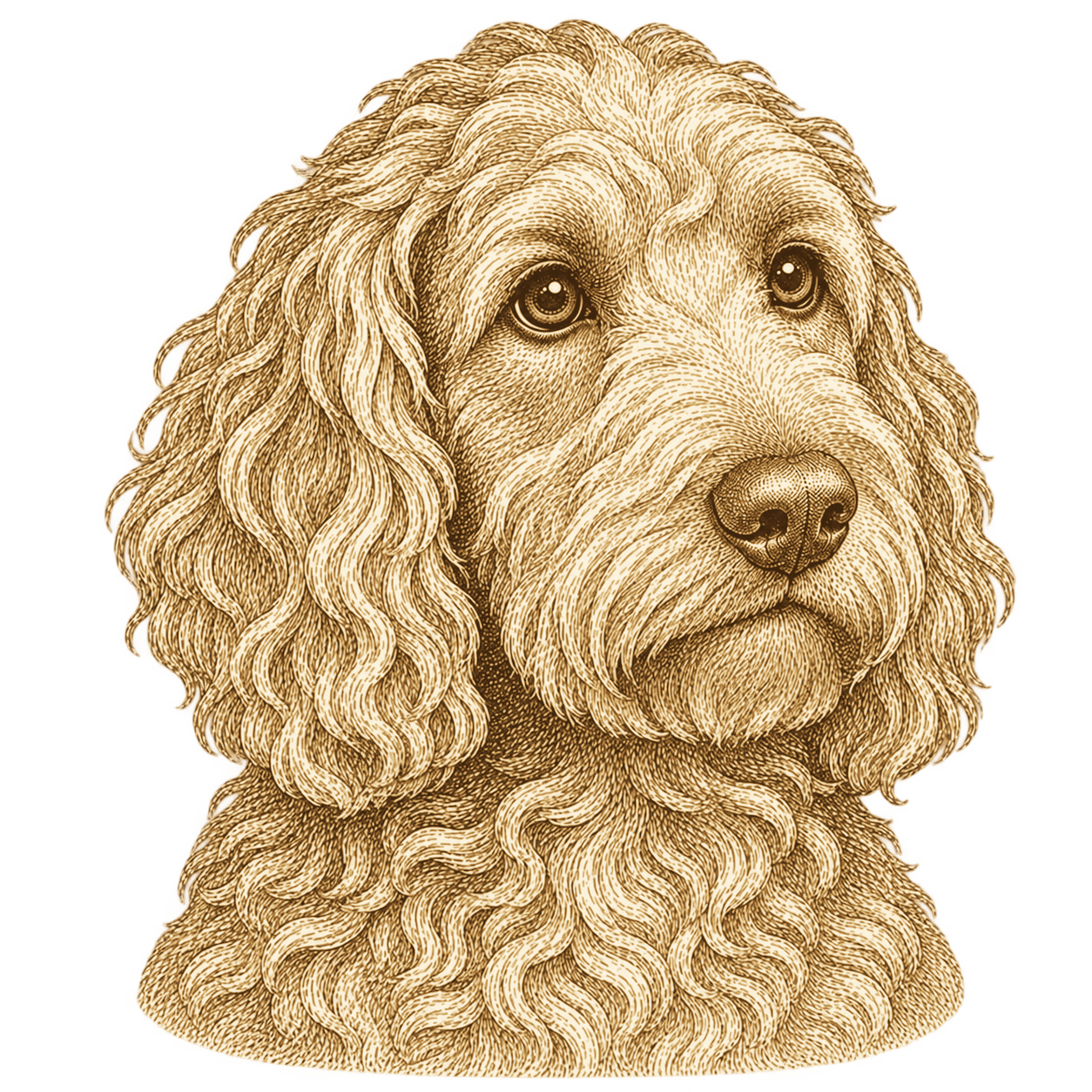
Labradoodle Training & Temperament: Breed Guide
The Labradoodle started life in 1989 at the Royal Guide Dog Association of Australia. Breeder Wally Conron crossed a Labrador Retriever with a Standard Poodle, hoping to produce a guide dog for a woman whose husband was allergic to dogs. One puppy from that litter fitted the bill, and the cross spread far faster than anyone involved expected. Conron has since said he regrets how quickly it was commercialised.
Both halves of the Labradoodle were bred to retrieve. The Labrador comes from the fishing and shooting traditions of Newfoundland and Britain, and the Poodle began in Germany as a water dog, fetching shot ducks from lakes and marshes. Whatever coat your Labradoodle ends up with, you're living with a dog built to fetch, carry, swim and work closely alongside a person.
In practice that tends to mean a sociable, people-focused dog with plenty of physical and mental energy and a mouth that likes to be busy. Because it's a cross, there's more variety between individual Labradoodles than you'd see in either parent breed. Size depends largely on which Poodle was used, so a Miniature Labradoodle is a much smaller, lighter dog than the standard version, which can easily match a big Labrador for height and strength.
Training approach for Labradoodles
-
Labradoodles inherit the Labrador's love of food and the Poodle's quick, attentive way of learning, which makes reward-based training a natural fit. Both parent breeds were developed to work cooperatively with a handler, so a Labradoodle tends to enjoy being given a job and paid well for doing it.
The Poodle side can also bring some sensitivity to handling and to a sharp tone of voice. Harsh corrections risk making a Labradoodle wary of hands, which causes real problems for a dog who'll need regular grooming for the rest of their life. Keeping training positive protects that trust.
-
Calm greetings come first, because a sociable dog who grows into a large, bouncy adult can easily knock someone over in excitement. Pair this with a settle on a mat, so your Labradoodle learns that switching off is something they're rewarded for too.
Grooming and handling deserve as much attention as any obedience skill. Brushing, touching paws and ears, and standing still on a table all need teaching gradually, long before the coat gets long enough to tangle.
Give that retrieving instinct a proper outlet. Teaching a reliable trade (swapping what's in their mouth for something better) and a structured retrieve keeps the carrying urge useful, and saves a lot of chasing round the kitchen table after a stolen slipper.
For standard-sized Labradoodles, loose lead walking is worth starting early, while the dog pulling on the other end is still small enough to manage comfortably.
-
Start handling and short grooming sessions in the first week your puppy is home, a minute or two at a time with plenty of treats. It's worth asking your groomer whether they offer a gentle puppy introduction visit, so the first proper groom isn't a full, long session.
Adolescence usually kicks in from around six months and can run well into the second year, especially for larger Labradoodles. Expect some skills to wobble during this stage, and keep practising calm greetings and settling, since this is when size, strength and enthusiasm all peak together.
Q & A
-
There's no guarantee. A first-generation Labradoodle can inherit a coat anywhere between the Labrador's shedding double coat and the Poodle's curly, low-shedding one, and you won't always know which until the adult coat comes through. Allergies are triggered by proteins in saliva and skin as well as hair, so even a low-shedding dog can still cause a reaction. If allergies are a concern, spend time around adult Labradoodles from the same breeder before committing.
-
You've got a dog descended from two retrieving breeds, so picking things up and carrying them around feels deeply rewarding. Chasing after them turns it into a brilliant game. Teach a trade instead, offering something better in exchange and then giving the item back where you safely can, and provide plenty of toys that are theirs to carry.
-
Reward four paws on the floor so generously that it becomes their default greeting, and ask visitors to wait until your dog is calm before saying hello. A Labradoodle who's been jumping up will often try harder at first when it stops working, so stay consistent. Keeping them on lead or behind a gate when guests arrive stops them practising it in the meantime.
-
Build it up at home first, with short sessions of brushing, touching paws and ears, and the sound of clippers or a hairdryer from a distance, all paired with treats. A chin rest, where your dog places their chin in your hand to say they're ready, gives them a way to take part in their own grooming. Little and often works far better than an occasional long, stressful session once the coat has already matted.
-
The Australian Labradoodle is a multi-generational line that also includes Cocker Spaniel and, in some lines, other breeds, bred over many years for more consistent coats and temperaments. Training principles are the same, though the Cocker influence can add a stronger nose and a keen interest in following scent. Expect a bit more predictability in coat and size than with a first-generation cross.
-
With water retrievers on both sides of the family, there's a good chance they'll head straight for any water they can see. Practise recall around water on a long line before trusting them off lead near the sea, rivers or ponds. Rinse off salt or muddy water afterwards and dry the coat right down to the skin, since a damp, curly coat mats quickly.
Is a Labradoodle right for you?
-
You want a sociable, affectionate dog who'll happily join in with family life, and you've got time each day for exercise, training games and something to keep their mouth and brain busy. You're comfortable with regular brushing at home and a professional groom every couple of months, and you'd enjoy a dog who loves fetch, swimming and muddy walks.
-
You need a dog who's guaranteed not to trigger allergies, since no Labradoodle can promise that. A standard-sized Labradoodle may also be too much if you've got very young children or unsteady visitors at home and limited time to work on calm greetings. If grooming costs or the time spent brushing would be a struggle, a shorter-coated breed will be easier to live with.
If you're in Brighton and Hove and want structured guidance for training your Labradoodle, my Puppy Foundation and Teen Reset programmes can help. Or check out my free Puppy Primer or Terrible Teen Survival guides for a practical starting point.