
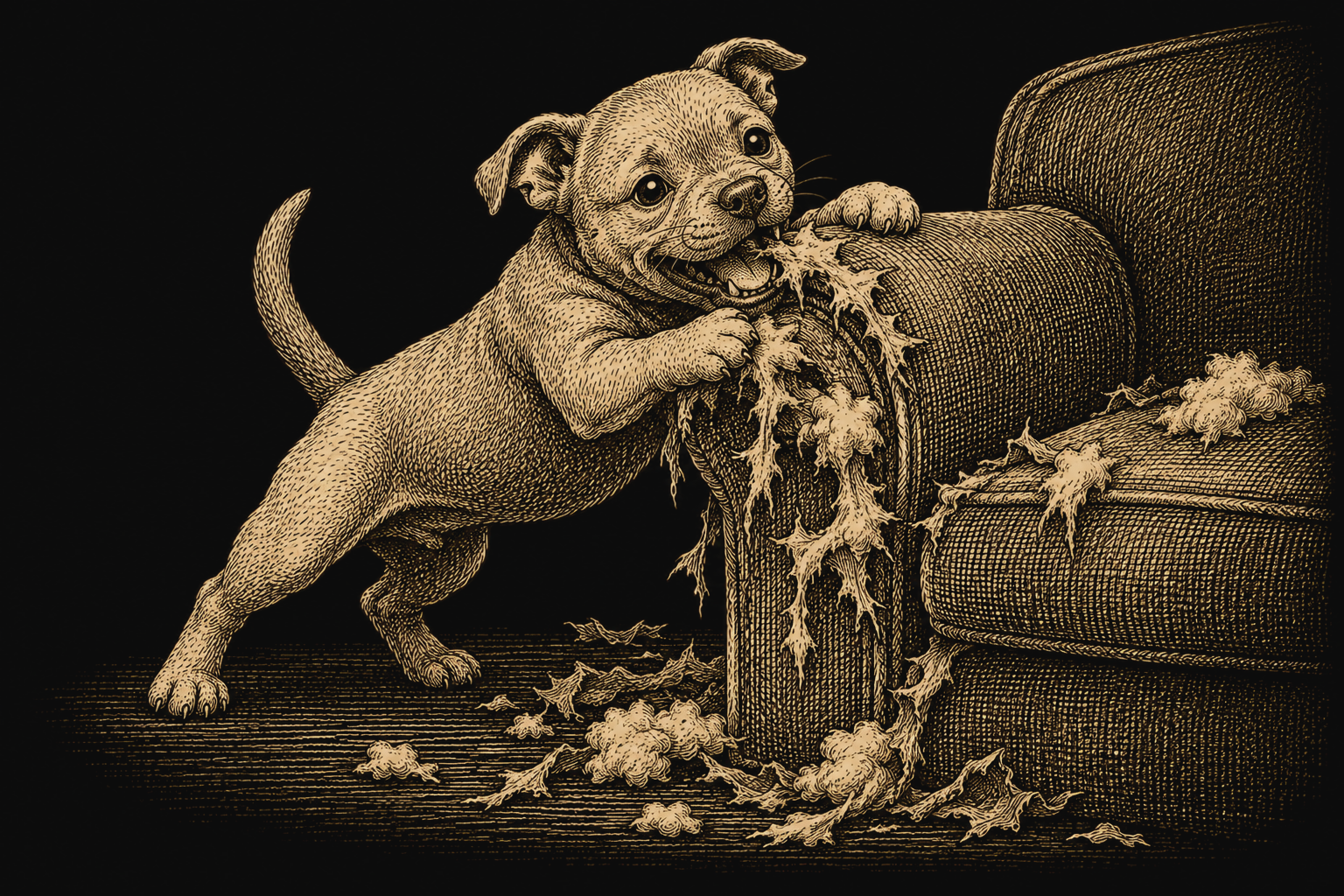
I made a reel recently for my "How Not To" social media series about coming home to find your dog has eaten the sofa, or more to the point, about how not to react when you do.
"How Not To" is also the thread running through my book, How (Not) to Train the Perfect Pup, where each chapter starts with the things we instinctively do that make life harder for us and our dogs, and then gets on to what actually helps. If you'd like to be one of the first to read it, you can join the waiting list here.
The reel only had time for the first half of the story, so this post is the rest of it: why the shouting doesn't work, why dogs chew the things they do, and what you can do about it.
Should you tell your dog off for chewing the sofa?
No. If you come home to a ripped-up sofa, telling your dog off won't stop it happening again, because they have no way of connecting your anger with something they did hours earlier. Dogs learn by linking what they do with what happens straight afterwards, and by the time you walk through the door, the chewing is long finished. Whatever they take from your reaction gets attached to what's happening at that moment, which is you coming home.
I completely understand the impulse. You walk in, there's stuffing all over the floor and a hole where the cushion used to be, and your first reaction is going to be a human one. It's worth taking a breath before you say anything, though, because the dog in front of you with their ears flattened and their eyes doing that sorrowful thing has a very different idea of what's going on.
What that "guilty look" really is
The lowered head, the averted eyes, the lip licking, the tucked tail and the slow slink off to another room are what behaviour researchers call appeasement signals. They're a dog's way of defusing tension when someone else is upset, and they come out in response to the person in front of them, whatever the dog has or hasn't done.
The best-known test of this was carried out by Alexandra Horowitz at Barnard College in New York in 2009. Owners told their dogs not to eat a treat and then left the room, and while they were out, the researcher either let the dog have the treat or took it away. The owners were then told, sometimes truthfully and sometimes not, whether their dog had eaten it. Whether the dogs looked "guilty" had nothing to do with whether they'd actually taken the treat. It depended on whether their owner told them off, and the guiltiest looks of all came from dogs who'd done nothing wrong and were being scolded anyway.
A team at Eötvös Loránd University in Budapest followed this up in 2012 with 64 dogs and found much the same thing. When owners came back into the room and simply greeted their dogs, the dogs who had eaten the forbidden food didn't behave any differently from the ones who hadn't. Being scolded was what brought the look out.
Where the look comes from
Those signals go back a long way. Dogs' ancestors lived in family groups where a proper fight could be costly for everyone involved, so a whole vocabulary of body language developed for calming things down before they boiled over: lowering the body, licking the lips, turning the head away. Thousands of years of living alongside us have since made dogs remarkably good at reading people. They pick up on our tone, our posture and our faces very quickly, which is why a dog can start slinking off before you've said a word, just from the way you stopped dead in the doorway.
There's even some evidence that we've shaped their faces along the way. In 2019, a team led by Juliane Kaminski at the University of Portsmouth compared the facial anatomy of dogs and wolves and found that dogs have a small muscle for raising the inner eyebrow, which in wolves is little more than a few scattered fibres. That raised eyebrow produces the "puppy dog eyes" look, which resembles the face people make when they're sad, and the researchers think dogs who could pull it off brought out a caring response in humans and were favoured as a result. It's a hypothesis, so take it with a pinch of salt, but it does suggest the face you're reading as remorse may have been shaped over thousands of years to work on people like you.
So when you shout and your dog gives you that look, they're doing what dogs have long done with an upset human, which is trying to calm you down. On this occasion it may not be working terribly well.
What shouting actually teaches them
Your dog will learn something from being shouted at, just not the lesson you had in mind. Marching them over to the sofa and showing them the damage doesn't help either. The RSPCA is clear that a dog won't connect your anger with something they did hours earlier, even at the "scene of the crime", and warns that punishing them makes them anxious about what will happen the next time you come home.
That matters, because a fair bit of chewing is driven by anxiety in the first place, particularly in dogs who struggle to be left alone. If your return starts to predict a telling off, the time before you get back becomes more stressful, and a stressed dog is more likely to chew. You can end up feeding the very thing you were trying to stop.
There's a wider pattern here too. A survey of UK dog owners by researchers at the University of Bristol in 2008 found that dogs whose owners used punishment were reported to have more behaviour problems overall, including more fear-related ones, than dogs trained using rewards. A survey can't prove the punishment caused the problems, but it fits with what trainers see, which is that frightening a dog rarely makes them easier to live with.
Why do dogs chew the sofa?
Chewing is a completely normal dog behaviour, and dogs of every age do it. The problem comes when it's aimed at the furniture, and there's usually a reason behind that. Since I work almost entirely with puppies and adolescent dogs, these are the ones I see most often.
Teething
Puppies lose their baby teeth from around three to four months, and the adult ones carry on coming through until roughly seven months. Their gums are sore for much of that time, and chewing helps. A puppy in the middle of teething will chew whatever they can reach, and a sofa cushion has the advantage of being soft, at mouth height and generally lying around.
Adolescence
The chewing doesn't stop the moment the adult teeth are in. Adolescent dogs often keep a heightened urge to chew until they're around 18 months old, and sometimes longer, and they've got a lot more jaw power than they had as puppies. So the damage can get noticeably more ambitious in the teenage months.
Boredom and not enough to do
A dog with energy and nothing to spend it on will find their own entertainment, and ripping the stuffing out of something is very satisfying. This tends to show up in breeds bred for work, like gundogs, collies and terriers, who were built to be busy for a large part of the day. I'd add that more exercise isn't always the answer, because a dog also needs things to do with their brain and their nose.
Tiredness and overarousal
This one surprises people. An overtired puppy or teenager often gets more frantic, and chewing and grabbing at things goes up along with everything else. If the destruction tends to happen at the end of a busy day, or in the evening witching hour, a lack of sleep may be part of it. I've written more about that in How Much Sleep Does a Puppy Need?
Finding it hard to be left alone
According to the RSPCA, research suggests around eight in ten dogs find it hard to cope with being left alone, and destructive behaviour is one of the most common signs. It's often aimed at doors, windows and other exits, or at things that smell strongly of you. Half of the dogs who struggle won't show any signs while you're in the house, so it's easy to miss, and it tends to start soon after you leave. If you think this might be what's going on, it's a different job from the other causes on this list, and it's worth getting proper help with it.
Frustration
Dogs who are stopped from getting to something they really want, like the cat on the other side of the window or the postie at the door, will sometimes redirect that frustration onto whatever's nearby, and grabbing and shaking a cushion is a common way out for it.
Habit and opportunity
If a dog has had the run of the sofa and chewing it felt good, it simply becomes something they do. Every time they get the chance to practise it, it gets a little more established.
Something medical
It's worth bearing in mind that a sudden change in chewing, particularly in an adult dog who's never done it before, can sometimes be linked to dental pain or a tummy upset. If it's come out of nowhere, a check-up with your vet is a sensible first step.
How do I stop my dog chewing the furniture?
The first job is working out which of those reasons you're dealing with, because the fix depends on it, and the two best clues are when it happens and what gets chewed. If you can, set up a phone or a cheap pet camera and film your dog for the first half hour after you go out. It takes the guesswork out of it, and it's often a bit of an eye-opener.
A puppy chewing anything within reach, whether you're home or not: teething
Damage near doors or windows, or to things that smell of you, starting soon after you leave: finding it hard to be left alone
Chewing in the evening or after a busy day, along with zoomies and grabbing: overtiredness
Chewing when they've had little to do, often in working breeds: boredom
Shredding near a window or door after barking at something outside: frustration
The same spot on the same sofa, time and again: habit
Once you've got a fair idea of the cause, this is the order I'd work through things in:
Take away the chance to practise it. While you're working on the rest, make the sofa unavailable when you can't keep an eye on them, using a puppy pen, a crate they're happy in, a baby gate or a closed door. Every successful chewing session makes the habit stronger, so this buys you time.
Give them something better to chew. Have a few safe chews and toys on offer in different textures, and swap them round every few days so they stay interesting. Whenever you see your dog chewing something of their own, let them know you like it with a quiet word or a treat.
Give their brain some work to do. Sniffing, licking and problem solving tire a dog out far more than people expect. Scatter feeding in the garden, a stuffed food toy or a lick mat before you go out, and a few minutes of training a day all help, and they're particularly useful for working breeds.
Make sure they're getting enough sleep. Puppies need 18 to 20 hours in every 24, and adolescents still need a lot more rest than you'd think. Planned naps in a quiet spot can take the edge off evening destruction surprisingly quickly.
Teach them that being alone is fine. Build up time on their own in very small steps, starting with seconds rather than hours, so it never becomes frightening. If your dog is already distressed when left, or you're seeing the signs listed above, speak to your vet, who can refer you to a qualified clinical animal behaviourist.
If you catch them in the act, keep it calm. Interrupt them without any drama, offer them something they're allowed to chew instead, and reward them for taking it. That's the moment when your dog can actually make the connection, which makes it the one moment worth doing something about.
The Dog's Honest Truth
Coming home to a shredded sofa is a bit annoying the say the least, and nobody is going to greet it with perfect calm every time. Your dog hasn’t got some kind of vendetta against your furniture though, and they aren't sitting there feeling sorry about it either. They're a dog doing something dogs do, for a reason that made sense to them at the time, and the face they pull when you walk in is their best attempt at smoothing things over with you.
The good news is that once you know why it's happening, destructive chewing is usually very fixable, and the work tends to make life better for both of you in other ways too, with a calmer, better-rested dog who's got more to think about and is happier in their own company.
If you've got a puppy and want to get ahead of it, Puppy Foundations covers chewing, sleep and alone time from the start. If you're living with a teenager who's already redecorating, Teen Resets is a good place to sort it out, and if you're not in Brighton, Remote Coaching works well for this kind of problem. Or get in touch and we can talk through what's going on with yours.
Sources
Horowitz, A. (2009) Disambiguating the "guilty look": salient prompts to a familiar dog behaviour. Behavioural Processes, 81(3), 447-452.
Hecht, J., Miklósi, Á. and Gácsi, M. (2012) Behavioral assessment and owner perceptions of behaviors associated with guilt in dogs. Applied Animal Behaviour Science, 139, 134-142. Summarised by the lead author here.
Kaminski, J., Waller, B.M., Diogo, R., Hartstone-Rose, A. and Burrows, A.M. (2019) Evolution of facial muscle anatomy in dogs. Proceedings of the National Academy of Sciences, 116(29), 14677-14681.
Blackwell, E.J., Twells, C., Seawright, A. and Casey, R.A. (2008) The relationship between training methods and the occurrence of behavior problems, as reported by owners, in a population of domestic dogs. Journal of Veterinary Behavior, 3(5), 207-217.
RSPCA. Recognising separation-related behaviour and anxiety in dogs.
RSPCA. Treating separation anxiety in dogs.
ASPCA. Destructive chewing.
Whole Dog Journal. When do puppies stop teething?